Physician CV Template: What Credentialing Bodies Actually Want

The CV that got you the job and the CV that helps you get credentialing done painlessly may be two different ones.
A hiring CV markets your experience and skills. A credentialing CV accounts for those things. Those are different jobs, and the second one is stricter than almost anyone tells you until your file comes back with questions about gaps, or someone asks you to track down the exact name of one employing entity or the other.
What makes a credentialing CV different
A credentialing coordinator is not reading your CV to be impressed. They are reading it to build an unbroken timeline of your professional life, then confirming each piece of it against a primary source. (You can see a version of this yourself by requesting your own NPDB self-query — it's the same kind of record a credentialing office builds on you, just from your side of the process.) If you put it on your CV, someone will check it.
That changes what a good CV looks like. Accomplishments still matter, but continuity matters enormously.
The three things that stall a file
- Dates without months. "2019 to 2022" is fine for a job application but isn't enough for credentialing. Every start and end date needs month and year. A coordinator working from year-only dates cannot tell whether you left in January or December, so they cannot tell whether a gap follows. They will write and ask, and your file will be delayed while these questions are being clarified.
- Gaps of 30 days or more. NCQA, the National Committee for Quality Assurance, is the body most payers point to for credentialing standards, and its own floor is more forgiving than what you'll experience in practice: gaps over six months need a verbal explanation, and gaps over twelve months need one in writing. But most CVOs and credentialing coordinators apply a tighter internal rule, closer to 30 days, because catching a gap early is faster than a file bouncing back from committee review with questions. Practically, that means the safe move is accounting for anything over 30 days, even though the regulatory floor is technically looser. A move, parental leave, a fellowship that started late, studying for boards, a stretch of caregiving: all of it counts once it crosses that line. A gap is not a problem. An unexplained gap is.
- Addresses and contacts you no longer have. Every training program and employer needs a full address and a contact the credentialing office can actually reach. Primary source verification hinges on the completeness of the information you pass on. This is the part people leave for last and then spend an evening reconstructing from memory and old emails. It makes every future round of credentialing harder than it needs to be.
The template
Copy this structure. Keep it in reverse chronological order (most recent to least recent), use month and year throughout, with no unexplained break longer than 30 days anywhere in the timeline. Remember that this is your credentialing CV. You should not be sharing this version until you are actively engaged in a credentialing process.
While the CV is not expected to tell the entire story, and other forms like Texas's TSCA (Texas Standardized Credentialing Application), or your state's own equivalent, may be required, the CV is where the credentialing professional will start.
Name and credentials: exactly as they appear on your license, including any former names.
Contact: address, phone, and an email you will still read in six months.
Identifiers: NPI, DEA number and expiration, state licenses with numbers and expirations.
Education: undergraduate, graduate, medical or nursing school. Institution, full address, degree, starting month and year to ending month and year.
Postgraduate training: internship, residency, fellowship. Program name, full address, program director, starting month and year to ending month and year.
Board certification: board, specialty, certification date, expiration or maintenance status.
Work history: every position since training, with employer, full address, supervisor or contact, and month and year to month and year.
Gap entries: any break of 30 days or more, with what you were doing and where.
How to write a gap entry
Keep it factual and short. It belongs in the timeline, in the same format as everything around it. Other documents requiring a more fleshed-out explanation exist, but your CV only needs a brief one.
June 2021 to February 2022. Parental leave. Chicago, IL.
March 2020 to August 2020. Graduation, relocation and state licensure pending. Austin, TX.
July 2019 to October 2019. Full-time board preparation. Boston, MA.
No lengthy explanation or detail you would rather not discuss is needed. A coordinator needs the months covered and a place. That is the whole ask.
Write it once
The reason this is worth doing carefully is that you only have to do it carefully once. The addresses do not change. Your residency dates are what they are, forever.In fact, most things stay exactly the same, but the process of keeping an organized ledger of your information can be tedious and time consuming.
What changes is the current job, the newest license, the most recent expiration. Those are additions to an existing record rather than a reason to rebuild it from scratch.
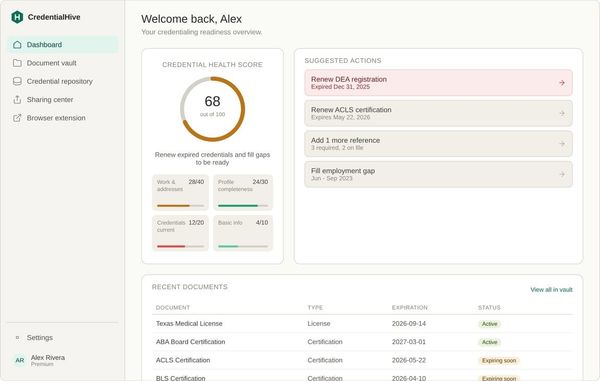
That is the whole idea behind CredentialHive. Upload the documents you already have and it pulls out the dates, numbers and addresses that applications keep asking for, then keeps them in one current record. Sensitive fields are encrypted and masked by default. When the next application wants your complete history to within 30 days, you are not reconstructing it. You are sending it via a single link in a record that follows and supports you for the rest of your career.
See how it works, or get access and start with the documents (organized or otherwise) on your computer right now.